
Dogs in History Part 9: Tudor and Stuart Britain — From Royal Hunts to King Charles’s Spaniels


By the Tudor period, dogs had become an established part of almost every level of British life. They guarded homes and property, hunted game, controlled vermin, worked alongside farmers and labourers, and lived within the households of the wealthy. In royal and aristocratic circles, however, dogs could represent far more than their practical purpose. They could communicate wealth, ancestry, political power, sporting ability and social status, while at the same time becoming deeply valued companions.
The Tudor and Stuart periods are particularly interesting because they show dogs occupying several roles at once. A dog might be a highly trained hunting animal, a heraldic symbol, an expensive fashion statement or a household pet. At the darker end of the spectrum, dogs were also bred and used for violent blood sports. This was a period in which the relationship between people and dogs was becoming increasingly diverse, laying some of the foundations for the modern idea of the companion dog while remaining firmly rooted in the working traditions of earlier centuries.
The Tudor Hunting Dog
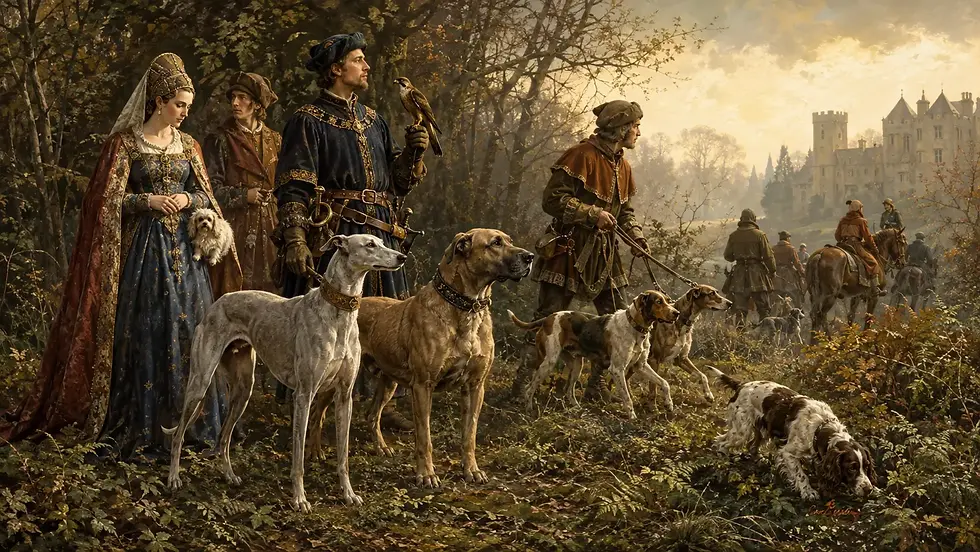
Hunting remained one of the defining activities of Tudor aristocratic life. It was not simply a pastime. Participation in the hunt demonstrated wealth, land ownership, physical ability and social standing, and maintaining the dogs, horses, servants and hunting grounds required for it was enormously expensive.
Henry VIII was an enthusiastic hunter, as were several other members of the royal family. Great royal residences such as Hampton Court were surrounded by extensive hunting grounds where deer and other game could be pursued. Dogs were essential to these activities, whether following scent, pursuing quarry or helping handlers locate and manage game.
Royal women also participated in hunting. Katherine of Aragon, for example, travelled with greyhounds, and surviving royal records demonstrate just how carefully elite hunting dogs could be managed. Dogs travelling with the Tudor court could be entrusted to an official known as a groom of the leash, whose responsibilities included caring for and handling the animals.
In 1528, Katherine's greyhounds were provided with extraordinarily elaborate equipment, including velvet collars, silver buckles and green silk leashes decorated with white roses. These objects were obviously functional, but practicality alone cannot explain their extravagance. The dogs themselves formed part of the spectacle of monarchy. A beautifully bred greyhound wearing expensive materials and royal symbols communicated the wealth and prestige of its owner just as effectively as clothing, jewellery, horses or heraldic decoration.
The Greyhound as a Symbol of Power
The greyhound could also carry political meaning. The White Greyhound of Richmond became one of the heraldic symbols associated with the Tudor dynasty and helped communicate the family's connections with earlier noble and royal houses.
Images of greyhounds appeared within royal decoration, including at Hampton Court Palace. To a Tudor audience familiar with heraldry, these animals were not simply decorative dogs. Their appearance could instantly communicate information about ancestry, legitimacy and dynastic identity.
In modern terms, it was something approaching political branding. Long before photography, television or social media, rulers surrounded themselves with recognisable symbols that helped reinforce who they were and why they believed they had the right to rule. Animals, including dogs, could become part of that visual language.
The greyhound was particularly suitable for such symbolism because it was already associated with elite hunting, elegance and aristocratic ownership. Its value therefore extended far beyond its ability to run.
Mastiffs and a Darker Side of Dog History
Not every use of dogs during the Tudor and Stuart periods fits comfortably with the modern idea of the human-dog relationship. Dogs were also deliberately bred, trained and used for blood sports, including bear baiting and bull baiting.
Large, powerful mastiff-type dogs were particularly associated with these activities. In baiting contests, dogs were encouraged to attack tethered animals while spectators watched and gambled on the outcome. Such spectacles could attract enormous crowds and were accepted forms of entertainment for people from several levels of society.
Royal enthusiasm sometimes helped legitimise these activities. James I was particularly interested in animal baiting, and records associated with the royal menagerie at the Tower of London describe mastiffs being used to bait lions.
From a modern perspective, the cruelty involved is difficult to comprehend, but it remains an important part of dog history. The relationship between humans and dogs has never consisted solely of companionship and affection. For centuries, people deliberately selected and trained dogs for tasks that involved aggression, combat and considerable physical danger.
Those decisions also influenced canine populations. When humans repeatedly bred dogs that possessed particular combinations of strength, persistence, athleticism, gripping behaviour or willingness to engage with large animals, they were shaping both the bodies and behavioural tendencies of future generations.
Understanding this history does not mean judging modern dogs according to the activities of their ancestors, but it does remind us that many physical and behavioural characteristics found in dogs today arose because people once considered those characteristics useful.
The Rise of the Spaniel
While some dogs were being bred for physically demanding or violent work, another transformation was taking place within aristocratic households. Small dogs were becoming increasingly fashionable as companions.
Spaniels themselves were certainly not new. For centuries, different spaniel-type dogs had been associated with hunting, particularly locating birds and flushing game from cover so that hunters could pursue it. Working spaniels therefore had a genuine practical role and were valued for their ability, enthusiasm and responsiveness.
Alongside these working dogs, however, smaller spaniels increasingly appeared inside elite households. These dogs were not necessarily required to perform the same demanding fieldwork as their larger relatives. Their value could instead lie in companionship, appearance and their association with fashionable court life.
Seventeenth-century paintings provide some of the clearest evidence for this changing relationship. Portraits increasingly show small spaniels sitting on laps, beside children or close to members of the aristocracy. Their positioning is significant. Rather than appearing outside as hunting equipment or symbols of field sports, they are shown physically close to people within intimate domestic settings.
A portrait of the infant future Charles II, painted in 1630, depicts him with a small toy spaniel sitting on his lap. The image is particularly important because it demonstrates that toy spaniels were already associated with the Stuart royal household before Charles became king.
They would soon become almost inseparable from his public image.
Charles II and His Spaniels
Few British monarchs are as closely associated with dogs as Charles II. His fondness for small spaniels became famous during his lifetime, and contemporary observers sometimes complained about the amount of attention he gave them, even when conducting affairs of state.
The dogs appear to have enjoyed considerable freedom within the royal household, and surviving records from 1662 include payment to a royal servant specifically responsible for walking the King's spaniels. They were therefore not merely occasional pets appearing in portraits. They were part of everyday life at court.
Charles's association with these dogs became so strong that the name King Charles Spaniel eventually emerged.
There is, however, an important historical distinction that is often lost in modern retellings. The spaniels living at Charles II's court were not identical to the dogs that we now call Cavalier King Charles Spaniels.
Toy spaniels changed considerably during the centuries after Charles's death. By the nineteenth century, fashions in dog breeding increasingly favoured shorter faces, rounder skulls and other exaggerated features, partly influenced by the popularity of brachycephalic Asian toy breeds such as the Pug and Japanese Chin.
As a result, the nineteenth-century King Charles Spaniel gradually developed a noticeably shorter muzzle than many of the small spaniels depicted in seventeenth-century paintings.
During the twentieth century, breeders deliberately attempted to recreate the longer-muzzled type visible in portraits from the time of Charles II. That revival eventually developed into the modern Cavalier King Charles Spaniel.
It is therefore misleading to say simply that Charles II owned Cavalier King Charles Spaniels. He owned seventeenth-century toy spaniels that belonged to an earlier population from which later breed traditions developed. The modern Cavalier is, in part, an attempt to recreate the appearance of those earlier dogs rather than an unchanged breed surviving directly from Charles II's kennels.
Dogs in Royal Portraits
Royal portraiture gives us a remarkable window into the variety of dogs living alongside wealthy families during this period.
One of the most striking examples is Sir Anthony van Dyck's famous 1637 portrait of the children of Charles I. Within the painting, a huge mastiff-type dog appears alongside the royal children, while a much smaller spaniel is also present.
The contrast is extraordinary.
The enormous dog projects strength, protection and status. A dog of that size would have been expensive to maintain and visually imposing, reinforcing the importance of the family surrounding it. The small spaniel, by comparison, occupies a far more intimate domestic role and reflects the growing popularity of dogs valued primarily for companionship.
Two very different dogs could therefore exist within the same royal household for completely different reasons.
Portraits such as these also remind us that dogs were becoming increasingly integrated into representations of family life. Their presence could communicate loyalty, nobility and affection, but in some images the relationship appears surprisingly familiar to modern eyes. Children touch them, adults hold them and small dogs sit comfortably within domestic interiors.
The companion dog was becoming increasingly visible.
From Working Animal to Household Companion
The Tudor and Stuart periods therefore show a remarkable expansion in the roles dogs occupied.
Working dogs remained essential. Hunting continued to dominate aristocratic recreation, while guarding dogs protected homes, livestock and property. Spaniels worked in the field, greyhounds pursued game and powerful mastiff-type dogs performed tasks that required strength and courage.
At the same time, wealthy households were increasingly maintaining dogs whose value extended beyond work. Small companion dogs could be kept because their owners enjoyed having them nearby. They could provide affection, amusement and social prestige while asking relatively little in terms of practical labour.
This does not mean that Britain suddenly invented the pet during the seventeenth century. Humans had formed affectionate relationships with dogs for thousands of years, and evidence for dogs treated as companions exists throughout antiquity and the medieval period.
What changes is the visibility and cultural importance of that relationship. By the Stuart period, the small companion dog had become an unmistakable feature of elite domestic life.
The dog was no longer found only in the kennel, hunting field, farmyard or gateway. It was increasingly appearing in the bedroom, drawing room and family portrait.
These Were Still Not Modern Breeds
Despite the familiar names used for many dogs during this period, Tudor and Stuart Britain did not yet possess dog breeds in exactly the way we understand them today.
People certainly bred dogs selectively. A successful hunting dog might be bred to another capable hunter, while greyhounds had been selected for generations for the physical characteristics required for speed. Spaniels were bred to produce dogs suited to locating and flushing game, and powerful dogs could be selected for guarding or physically demanding work.
However, these populations were generally more flexible than modern pedigree breeds.
A seventeenth-century spaniel might vary substantially in size, coat, colour and appearance. The term mastiff described a broad type of powerful dog rather than a population governed by a modern written breed standard. Even greyhounds, which already possessed a relatively distinctive body shape because of the demands of their work, existed centuries before kennel clubs and officially regulated stud books.
The primary question was still usually whether a dog could successfully perform the role for which it was intended.
Appearance mattered, particularly among the wealthy, and fashions certainly influenced breeding. However, dogs had not yet been divided into the precisely defined pedigree populations familiar to modern owners.
That transformation would accelerate dramatically during the nineteenth century.
Before the Victorians Changed Everything
By the end of the Stuart period, many of the ingredients of modern dog ownership were already present. Britain had specialist hunting dogs, powerful guarding dogs, small companion dogs and people deliberately breeding animals for particular characteristics. Dogs appeared in family portraits, slept within wealthy households and could become strongly associated with individual owners.
What Britain did not yet have was the modern pedigree system.
During the nineteenth century, Victorian enthusiasm for classification, exhibitions and organised breeding would dramatically alter the way dogs were understood. Dog shows emerged, breed standards were written, kennel clubs were founded and increasingly closed populations were created.
The question people asked when breeding dogs gradually began to change.
For much of history, the most important question had been: What can this dog do?
Increasingly, another question began to matter just as much: Does this dog look exactly as a member of its breed is supposed to look?
That shift would transform dogs more dramatically than almost anything that had happened during the previous several thousand years.
The age of the modern dog breed was about to begin.

Comments