
Dogs in History Part 7: The Vikings — Hounds, Voyages and Dogs in the Grave

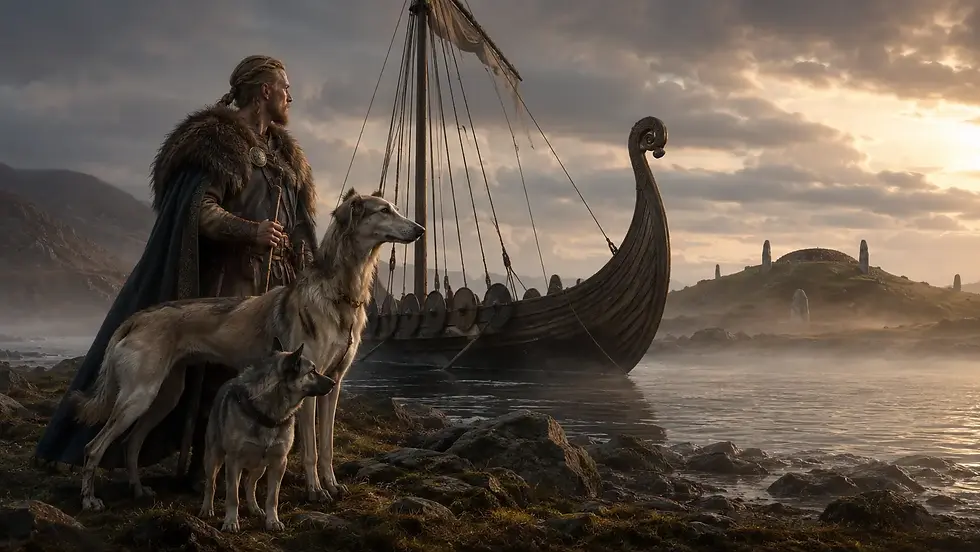
Mention the Vikings and most people picture longships cutting through cold northern seas, warriors carrying swords and shields, and perhaps a raven circling overhead. Dogs rarely feature in the popular image of Viking life, yet archaeology tells a very different story. Dogs lived throughout Viking-Age communities and appear in some of the most remarkable burials discovered in Scandinavia and beyond. They hunted alongside people, guarded homes and property, travelled with their owners across considerable distances and, in some cases, were deliberately killed and buried or cremated as part of human funerary rites.
There Was No Single “Viking Dog”
The Viking Age stretched across several centuries and covered an enormous geographical area, from Scandinavia into Britain, Ireland, continental Europe and far beyond. It would therefore be misleading to imagine that there was one standard type of “Viking dog”. Archaeological evidence instead reveals a varied canine population, with dogs differing considerably in size, proportions and likely function.
Research on dogs recovered from the burial grounds at Valsgärde in Sweden, for example, identified the remains of at least twenty individual dogs from Vendel- and Viking-Age graves. Most of these animals were medium to large, but researchers found enough variation in their skeletal proportions to suggest that several distinct physical types were present. Some were more robust, while others were taller and more lightly built.
This is an important reminder when looking at reconstructions or photographs of ancient Scandinavian dogs. There is a tendency online to identify almost every spitz-like archaeological dog as a modern Scandinavian breed, but the evidence rarely allows us to make such precise identifications. Viking-Age communities were undoubtedly selecting and breeding dogs for useful characteristics, including hunting ability, size, temperament and physical performance, but this was not necessarily the same as the tightly controlled, closed pedigree breeding systems that define modern dog breeds.
Hunting Dogs and Social Status
Hunting would have been an important activity for many Scandinavian communities, providing food, materials and, particularly among wealthier groups, an opportunity to demonstrate skill and status. Dogs were valuable partners in this process, and some archaeological evidence suggests that particularly impressive hunting dogs may have been associated with elite households.
Researchers examining three Viking-Age dogs discovered in boat graves at Gamla Uppsala in Sweden found that two were unusually large, slender and hound-like in their proportions. Similar dogs have been identified at other high-status burial sites in the region, leading researchers to suggest that specialised hunting hounds may have formed part of elite Scandinavian culture.
Such dogs would have represented far more than a practical hunting tool. Producing, feeding and training an effective hunting animal required time and resources, while successful dogs could have been extremely valuable. Just as horses, weapons and elaborate equipment could communicate a person’s wealth or social standing, ownership of impressive hunting dogs may also have carried considerable prestige.
This does not mean that every large dog belonged to an aristocrat or that every dog placed in an important grave was a hunting specialist. Nevertheless, the repeated appearance of large, distinctive dogs in elite burials suggests that certain types of dog had particular social importance and may have been closely connected with the identity of their owners.
Dogs in Boat Graves
Some of the most striking evidence for the relationship between humans and dogs during the Viking Age comes from burials. Whole or partial dog remains have been found in a number of Scandinavian graves, including elaborate boat burials where people were interred alongside weapons, household objects, horses and other animals.
At Gamla Uppsala, dogs were found in boat graves together with human remains and other grave goods. At Valsgärde, dogs appeared repeatedly in funerary traditions spanning several centuries. Their inclusion was clearly deliberate, but determining exactly what they represented is considerably more difficult.
A dog placed in a grave could have symbolised many things. It might have reflected the deceased person’s status, their identity as a hunter, the practical value of the animal, a religious or supernatural belief, or a personal relationship between human and dog. Several of these meanings could also have existed simultaneously.
Modern audiences understandably find the idea of dogs being buried with their owners emotionally powerful, but we should be careful not to automatically interpret every archaeological dog as a beloved pet sacrificed so that it could remain beside its person. Archaeology cannot tell us exactly what an individual human felt about an individual animal. At the same time, it would be equally misleading to assume that dogs were regarded only as disposable tools. Researchers studying the Valsgärde animals have noted evidence suggesting that some individual dogs may have possessed considerable social or personal value.
The most reasonable conclusion is that Viking-Age relationships with dogs were probably complex. A dog could be useful, valuable, prestigious and emotionally important at the same time, just as working dogs can be today.
Vikings Brought Their Dogs With Them
One of the most remarkable pieces of evidence for the importance of dogs in Viking society comes not from Scandinavia, but from England. At Heath Wood in Derbyshire, the only known large Scandinavian cremation cemetery in Britain, researchers examined human and animal remains associated with Viking settlers connected with the Great Army that arrived in England during the ninth century.
Using strontium isotope analysis, scientists were able to investigate where some of the individuals and animals had grown up. The results suggested that a dog and a horse found at the cemetery were not local to Britain. Their isotopic signatures were consistent with origins within the Baltic Shield region of Scandinavia.
In practical terms, this means that Scandinavian travellers appear to have crossed the North Sea with their animals rather than simply acquiring replacements after arriving in Britain. That is an extraordinary detail because transporting a dog on a long Viking-Age journey required genuine commitment. Space had to be found aboard a vessel, food and water had to be provided, and the animal had to be managed during a potentially difficult sea crossing and subsequent overland travel.
A dog taken on such a journey was therefore unlikely to have been insignificant. Whether it was a hunting animal, guard dog, valued companion or a combination of these roles, someone considered it important enough to bring across the sea and into an entirely new country.
Dogs Travelled Farther Than We Once Realised
Evidence from other parts of northern Europe suggests that Viking-Age dogs were moving considerable distances within human networks. Researchers studying dogs from the large cemetery at Luistari in Finland have used isotope analysis to investigate where some of these animals may have originated. The results suggest that at least some dogs could have come from outside the immediate region, potentially including southern Scandinavia.
This raises fascinating questions about the movement and value of dogs during the Viking Age. Animals could have travelled with migrating families, accompanied traders or warriors, been exchanged as gifts, or perhaps been deliberately sought out because they possessed desirable working characteristics.
The long-distance movement of valued dogs is therefore not a modern phenomenon. For thousands of years, humans have been interested in acquiring animals that could perform particular tasks or possessed particular physical and behavioural traits. Viking-Age Scandinavia appears to have been no exception.
Dogs in Norse Mythology
Dogs and dog-like creatures also appear in the surviving mythology of the Norse world, although this is an area where modern retellings often go much further than the evidence allows.
Fenrir, one of the most famous animals in Norse mythology, is explicitly described as a monstrous wolf rather than a domestic dog. Garmr, another supernatural canine associated in later literary traditions with the world of the dead, is sometimes described as a dog, hound or wolf-like creature. However, the surviving written sources describing these beings were recorded centuries after parts of the belief system had developed, often by Christian authors writing in medieval Iceland.
For that reason, it is risky to look at an archaeological dog burial and confidently declare that the animal was intended to guide its owner to Valhalla, guard an entrance to the underworld or perform some other specific supernatural task. The archaeological evidence simply cannot demonstrate this.
There may well have been religious or symbolic meanings attached to dogs, particularly given their repeated inclusion in funerary contexts, but we should resist filling gaps in the evidence with attractive modern stories. What archaeology can show us is already remarkable without embellishment.
Beside Them in Life — and in Death
Viking-Age dogs were clearly woven into human society. They worked, hunted and probably guarded homes, settlements and animals. Some appear to have belonged to wealthy or powerful households, while others may have lived in much more ordinary communities. Certain dogs travelled extraordinary distances with people, crossing seas and moving through extensive trade and migration networks.
Some were also deliberately included in human funerals, sometimes in elaborate graves that contained weapons, horses and valuable possessions. Their presence tells us that dogs could hold considerable practical, social and perhaps symbolic importance.
Like dogs throughout history, these animals were also being shaped by human choices. People were selecting dogs for the characteristics that mattered to them, whether that meant size, speed, hunting ability, strength or temperament. They may not have been breeding modern pedigree dogs, but they were already influencing canine populations to produce animals suited to particular roles.
Perhaps the most revealing evidence comes from the journeys themselves. Viking-Age people crossed dangerous seas with their dogs. They made room for them aboard ships, fed them along the way and carried them into new settlements hundreds of miles from the places where they had been born.
They hunted with them, lived beside them and sometimes buried them with their dead.
The dog did not stand outside Viking society. It was quite literally travelling with it.


Comments