
Dogs in History Part 8: Dogs of Medieval Britain — Hounds, Alaunts, Spaniels and Lapdogs

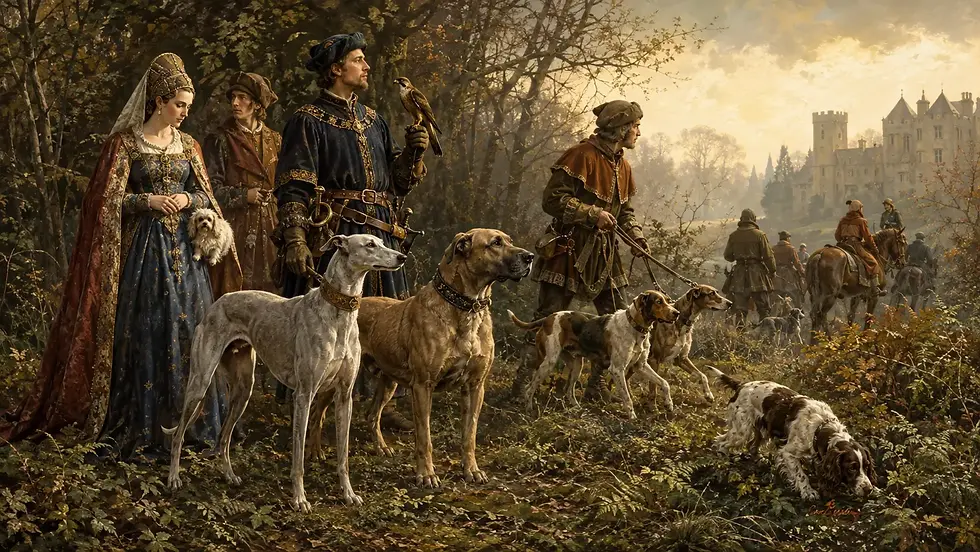
If you could travel back to medieval Britain and ask someone what breed of dog they owned, their answer might sound familiar at first. They might describe their dog as a greyhound, a mastiff, a spaniel, an alaunt or a running hound. However, these words did not necessarily describe breeds in the modern pedigree sense. Instead, they often referred to broad types of dog distinguished by their appearance, their geographical origin and, perhaps most importantly, the work they were expected to perform.
Long before the creation of modern kennel clubs and written breed standards, people were already selectively breeding dogs for particular characteristics. Medieval society developed an impressive variety of working dogs, particularly for hunting, guarding and companionship. Their names, bodies and behaviours reflected the jobs humans needed them to do.
Hunting Was Serious Business
For the medieval elite, hunting was far more than a recreational pastime. It was closely connected with wealth, status, land ownership and social position. Large areas of land could be managed specifically for hunting, and maintaining kennels of specialist dogs required considerable resources. A successful hunt could demonstrate not only the skill of the hunters but also the quality of the animals and servants maintained by a wealthy household.
Dogs were central to this culture. One of the most important surviving medieval hunting texts is Gaston Fébus's Livre de la chasse, written during the late fourteenth century. Illustrated copies of the work contain detailed depictions of different types of hunting dogs, including alaunts, greyhounds, running hounds, spaniels and mastiffs. These were not simply generic dogs placed decoratively into hunting scenes. Different types were recognised as having different abilities and were selected for particular roles.
The illustrations also provide a remarkable glimpse into the everyday management of medieval working dogs. Dogs are shown living in kennels, being groomed and handled, being walked individually on leads and being prepared for work. Other scenes depict handlers developing the dogs' ability to follow scent and manage themselves during a hunt. Medieval hunting therefore involved far more than releasing a collection of dogs into the countryside and hoping instinct would take care of everything. It required organisation, knowledge and deliberate training.
Different Dogs Had Different Jobs
Different forms of hunting demanded dogs with very different physical and behavioural characteristics. Greyhound-like dogs were valued for their speed and their ability to pursue quarry that they could see. A fast, lightly built dog capable of accelerating quickly across open ground needed a very different body from an animal expected to follow scent for prolonged periods.
Running hounds worked in a different way. Rather than relying primarily on sight, scenting hounds could track animals over distance and help hunters locate and pursue quarry through woodland and across the countryside. Their value depended not simply on speed but on persistence, scenting ability and the willingness to continue following a trail.
Spaniel-type dogs developed yet another working role. They could search through vegetation, cover and undergrowth to locate or flush game for hunters. Their work demanded an animal willing to investigate dense environments, remain engaged with scent and cooperate closely with the human hunter.
Powerful mastiff-like dogs were valued for strength and could be used in guarding and other physically demanding roles. Another recognised medieval dog type was the now-extinct alaunt, which appears repeatedly in medieval hunting literature. The exact appearance and ancestry of the alaunt are difficult to reconstruct, and it should not simply be treated as an identical ancestor of any one modern breed. Nevertheless, historical descriptions suggest that it was recognised as a powerful and useful working type.
The enormous variation between these dogs was not accidental. Their bodies reflected their jobs because humans had been selecting animals according to performance for generations. If a community needed faster dogs, successful fast dogs could be bred together. If hunters required animals with exceptional scenting ability, dogs that demonstrated that talent could be selected for breeding. If strength, courage or guarding behaviour was desirable, those characteristics could also influence which animals produced the next generation.
Over time, behavioural selection inevitably affected physical appearance. Dogs bred repeatedly for speed became lighter and more athletic, while animals selected for power became heavier and more robust. Long before anyone wrote an official breed standard, people were therefore shaping both the bodies and the minds of dogs.
Medieval Dog Training
The surviving hunting manuscripts are particularly interesting because they demonstrate that medieval people understood that successful working dogs required training as well as breeding. Instinct might provide the foundations of a behaviour, but handlers still had to develop, direct and control those instincts.
Illustrations in Livre de la chasse show dogs being handled on leads, learning to work with scent and being carefully prepared before hunting. One scene even depicts trainee hunters learning the names of individual dogs, suggesting that successful hunting depended on knowing the animals themselves rather than regarding them as interchangeable pieces of equipment.
A good hunting dog therefore needed a competent human handler. Dogs had to learn how to work within a system, respond to people and perform particular tasks under demanding conditions. The methods may have been very different from those used by modern trainers, but the underlying principle is immediately recognisable: genetics can provide natural ability, but training determines how effectively that ability is used.
Dogs, Wealth and Social Status
Dogs could also communicate something about the status of the people who owned them. Maintaining specialist hunting dogs required considerable resources. Dogs had to be bred, fed, housed, exercised and trained, while large hunting establishments could require dedicated servants or huntsmen responsible for their care.
A beautifully bred, well-trained hunting dog was therefore not only a practical working animal but also evidence of wealth. Medieval manuscripts frequently depict aristocratic men and women hunting alongside their dogs. Greyhound-like dogs appear pursuing hares, packs of hounds chase deer and attendants are shown leading carefully managed dogs on leashes.
Possessing the right dogs could demonstrate that someone had the land on which to hunt, the money required to maintain the animals and the social position that allowed participation in elite hunting culture. In that sense, the medieval hunting dog was both a working partner and a form of social currency.
What About Medieval Pets?
Not every dog in medieval Britain spent its life hunting or guarding. Smaller companion dogs also appear in medieval art and literature, particularly in wealthy households. These small dogs are sometimes depicted alongside women and children, sitting on laps or occupying domestic spaces rather than working in fields or forests.
It is tempting to look at these images and immediately describe the animals as pets, but the word needs to be used with some caution. Medieval people did not necessarily divide animals into the same categories that modern society does, and an animal could potentially be both useful and valued as a companion.
Nevertheless, there is clear evidence that people were capable of forming affectionate relationships with individual animals. The idea that humans only recently began loving dogs is simply not supported by history. Medieval owners could care deeply about particular dogs, even though their wider attitudes towards animals differed considerably from our own.
Lapdogs are particularly interesting because they demonstrate that selective breeding was not driven exclusively by work. Humans were also choosing dogs because they enjoyed having them nearby. Small size, appearance, manageable temperament and companionship could all become desirable characteristics in their own right.
The Faithful Dog
Dogs also occupied an important symbolic place within medieval culture. Bestiaries, which combined observations about animals with Christian teaching, mythology and moral stories, frequently used dogs as symbols of loyalty and faithfulness.
A thirteenth-century bestiary held by the British Library, for example, contains illustrations of dogs hunting, dogs accompanying shepherds and a story in which a dog identifies the person responsible for murdering its master. Such stories should not be treated as scientific descriptions of canine behaviour. Medieval bestiaries routinely mixed genuine observations with folklore and religious symbolism.
However, the choice of the dog as a symbol of loyalty remains significant. Symbolism only works when the audience already recognises the quality being represented. Medieval readers evidently understood the dog as an animal capable of attachment, faithfulness and devotion to people.
The image of the loyal dog, therefore, is not a modern invention. The association between dogs and human companionship had already become deeply embedded in European culture many centuries ago.
A World Before Pedigree Breeds
Perhaps the most important thing medieval dogs can teach us is that highly specialised dog populations existed long before the development of modern pedigree breeding.
Medieval hunters clearly understood that dogs differed from one another. They deliberately selected animals with useful characteristics, bred successful dogs and developed different types suited to different tasks. What they did not have were kennel clubs, closed stud books, universally agreed written standards or formal registration systems defining exactly what each dog should look like.
Performance remained enormously important. A dog intended to hunt ultimately needed to demonstrate that it could hunt. Appearance mattered because physical structure affected performance, but there was little value in producing a perfectly shaped hunting dog that was incapable of performing the job for which it had been bred.
This is one of the major differences between many historical working populations and modern pedigree breeds. Modern breeds are often defined primarily through ancestry and conformity to a written standard, whereas historical dog types were frequently maintained through a combination of appearance, geographical tradition and practical ability.
That does not mean medieval breeding was unsophisticated. In many ways, it was extremely sophisticated. Generations of hunters understood that breeding dogs with particular characteristics increased the likelihood of producing offspring capable of similar work.
The Medieval Legacy
Many of the words we now associate with recognised breeds have much older histories. Terms such as hound, spaniel, mastiff and greyhound existed long before the modern pedigree system developed, although their meanings and the populations they described changed considerably over time.
Modern breeds should therefore not automatically be treated as genetically unchanged versions of medieval dogs simply because they share the same name. Centuries of selective breeding, crossbreeding, changing fashions and eventually formal breed standards transformed dog populations considerably.
What remained remarkably consistent was the human desire to shape dogs according to particular purposes. For hundreds of years, people selected dogs that could run quickly, follow scent, search cover, guard property or remain close as companions. Those choices influenced not only what dogs looked like but also how they behaved.
This is one of the most important lessons that the medieval dog can offer the modern owner. When we look at a dog today, it is easy to see primarily a family pet. Yet behind many modern breeds lie generations, and sometimes centuries, of selection for particular patterns of behaviour.
A hound's desire to follow a scent, a spaniel's determination to search through vegetation, a sighthound's response to fast-moving objects or a guarding breed's awareness of people approaching its territory are not simply inconvenient habits that appeared by accident. They are echoes of the work humans once deliberately encouraged.
The medieval dog reminds us that dogs were not originally created simply to fit into our homes. Their bodies were shaped for particular purposes, their brains were selected to perform particular tasks, and their instincts were developed because those behaviours once had enormous value to us.
Centuries later, many of those dogs may now spend their evenings sleeping on sofas rather than following deer through forests or guarding medieval estates, but the behavioural inheritance of their working past has not simply disappeared. Understanding that history can help us understand the dogs living beside us today.


Comments