
The Dogs That Do Not Fit Neatly Anywhere Else: Understanding Utility Breeds

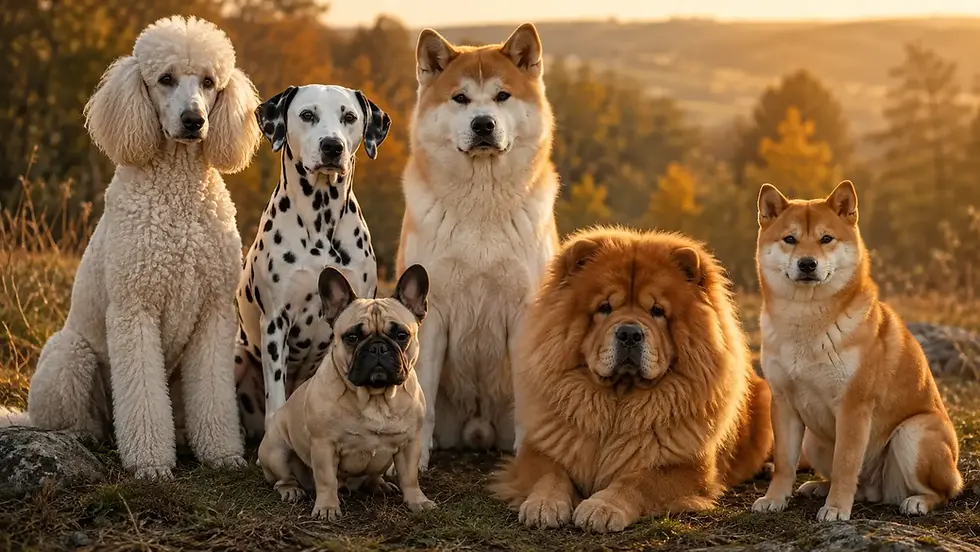
The Utility Group is one of the most interesting breed groups because it is not united by one single historical job. Sighthounds were shaped by visual pursuit, scent hounds by tracking, gundogs by cooperative hunting and terriers by vermin control, but Utility breeds are far more varied. The group includes dogs developed for guarding, companionship, water work, sled work, vermin control, temple life and highly specialised tasks that do not fit comfortably within the other breed categories. This makes the group less predictable as a whole, but also more fascinating, because each breed needs to be understood through its own history rather than through a single shared behavioural pattern.
That variety is exactly why owners can get caught out. A French Bulldog, Akita, Dalmatian, Shiba Inu, Poodle and Tibetan Spaniel can all sit within the same broad group while having dramatically different temperaments, energy levels, social tendencies and working backgrounds. Some are highly social, some are naturally reserved, some are independent, some are strongly handler focused, and some possess powerful guarding or hunting instincts. The Utility label therefore tells us far less about the individual dog than it does in many other groups, which means breed history becomes especially important when deciding what the dog is likely to need.
What Exactly Is the Utility Group?
The Utility Group is effectively a collection of breeds that do not fit neatly into the other traditional categories. Historically, many of these dogs performed very specific jobs that were important within particular cultures or environments, but those roles were too unusual or too varied to justify a separate group. Some breeds were developed primarily as companions, while others worked as guards, carriage dogs, water dogs or hunting dogs. A few have ancient or primitive origins, and others are much more recent creations shaped by changes in human taste and fashion.
This means there is no single behavioural profile that defines a Utility dog. Instead, owners need to ask what the breed was originally selected to do, what traits made it successful at that job and which of those traits are likely to remain strong in a modern pet. A dog bred for independent guarding is likely to view strangers very differently from a breed developed to accompany humans closely, while a dog that historically worked over large distances may have very different exercise needs from one created primarily for companionship.
The most useful way to understand the Utility Group is therefore to treat it as a collection of specialist dogs rather than one coherent working type. The common theme is not behaviour but difference, and that is why careful breed selection matters so much.
Why Breed History Matters More Than the Label
Because Utility breeds are so diverse, relying on the group name alone can be misleading. Two dogs in the same category may have almost opposite behavioural tendencies. One may be naturally social and eager to greet unfamiliar people, while another may be suspicious of strangers and highly selective about contact. One may thrive on intense activity, while another is better suited to moderate exercise with plenty of rest.
This is why choosing a Utility breed based primarily on appearance can create problems. The dog’s coat, size or expression may be appealing, but those features tell us very little about the behaviour underneath. A dramatic-looking Akita and a cheerful-looking Dalmatian are both physically striking, but their social expectations and working histories are very different. Understanding what humans selected the breed to do is far more useful than deciding whether the dog looks calm, cuddly or athletic.
The Importance of Early Socialisation
Socialisation is important for every breed, but within the Utility Group it often needs to be tailored very carefully to the individual dog. Some breeds are naturally outgoing and may need more work on neutrality because they can become over-excited by people or dogs. Others are naturally reserved and may need confidence-building without being pushed into unwanted interaction. The aim should always be to create a dog that can move through the world calmly rather than one that feels compelled to greet everything or defend itself from everything.
Puppies should experience people of different ages and appearances, other dogs, traffic, handling, grooming, different surfaces and a variety of environments while remaining within their ability to cope. For naturally aloof breeds, socialisation should never mean forcing physical contact with strangers. A well-socialised dog does not need to love everyone; it needs to understand that unfamiliar people can exist without posing a threat.
Neutrality Is Especially Important
Many Utility breeds benefit enormously from learning neutrality because several have either strong social excitement or strong social reserve. A dog that is allowed to greet every person may become frustrated when access is later denied, while a naturally suspicious dog that is repeatedly pushed into greetings may become increasingly uncomfortable. Both situations can produce behaviour that owners later describe as reactivity.
Neutrality means the dog can observe people, dogs, movement and novelty without becoming completely absorbed. This is particularly useful for breeds that can be intense, powerful or independent, because the goal is not simply control in the moment but a calmer emotional response over time. Teaching a puppy that not everything in the environment requires action gives the adult dog far more flexibility.
Independence and Handler Focus
Some Utility breeds are highly cooperative with people, while others were developed to make decisions more independently. This difference can affect everything from recall to engagement and frustration tolerance. Owners accustomed to naturally handler-focused dogs may find some Utility breeds surprisingly uninterested in repetitive training, while other breeds within the same group may thrive on constant interaction.
Independent dogs are not necessarily stubborn. In many cases, independence was useful because the breed needed to make decisions without waiting for human instructions. Training should therefore be structured around motivation, clarity and meaningful reinforcement rather than endless repetition. A dog that does not automatically look to the owner for every decision can still become highly trainable when the relationship and reward structure make sense.
Exercise Needs Vary Dramatically
One of the biggest mistakes with Utility breeds is assuming that every member of the group has similar exercise requirements. The reality is far more varied. Some breeds were developed for substantial endurance and can cover considerable distances, while others have physical structures that make intense exercise inappropriate.
Exercise should therefore be matched to the breed and individual rather than to a generic rule. The dog’s age, health, body structure and historical function all matter. A young Dalmatian may need significant physical and mental activity, while a brachycephalic companion breed may require much more careful management because heat and respiratory function can limit safe exertion.
The aim should never be to simply exhaust the dog. Meaningful walks, scent work, training, controlled play and breed-appropriate outlets usually provide far better balance than endless mileage alone.
Calmness Still Needs to Be Taught
Many owners focus heavily on physical exercise but neglect the dog’s ability to rest. This can be especially problematic in breeds that are naturally busy, excitable or highly alert. A dog that is constantly entertained can become dependent on stimulation and may struggle to settle without activity.
Teaching calmness should therefore begin during puppyhood. The dog should learn how to rest in a quiet space, settle after walks, relax while people move around the home and tolerate periods when nothing exciting is happening. This does not mean creating a dull life. It means teaching the dog that activity and rest are both normal parts of the day.
Dalmatian
The Dalmatian has one of the most distinctive histories within the Utility Group. The breed became strongly associated with carriages, where dogs travelled alongside horses and acted as guards, companions and highly visible symbols of status. This background required stamina, confidence and the ability to move for long distances, and those traits remain very obvious in many modern Dalmatians.
Dalmatians are often highly energetic, intelligent and strongly bonded to their families. They can also be boisterous, easily over-aroused and extremely physical when young. If calm greetings, lead manners and frustration tolerance are neglected, an adolescent Dalmatian can become difficult simply because of the combination of strength and enthusiasm.
They benefit from substantial exercise, but running alone is not enough. Training, scent work, structured walking and problem-solving provide important mental outlets. Because the breed can be sensitive, consistent handling and early socialisation are particularly valuable. Prospective owners should also understand the breed’s association with deafness and urinary urate problems and should choose breeders who carry out appropriate health testing.
Poodle
The Poodle is frequently treated as a glamorous companion breed, but its origins are closely connected to water retrieving. Standard Poodles in particular were developed as intelligent working dogs capable of retrieving from water, and the elaborate coat styling associated with the breed has historical links to practical trimming around swimming and cold conditions.
Poodles are highly intelligent, active and often extremely people focused. Their intelligence means they can learn quickly, but it can also create problems if they are under-stimulated because they become very good at inventing their own activities. Repetitive exercise alone is rarely enough to satisfy them, and they usually thrive on varied training, scent work, retrieving and problem-solving.
The breed exists in Standard, Miniature and Toy sizes, and while there are broad temperament similarities, size and breeding can influence behaviour and exercise requirements. Grooming is a major practical commitment across all varieties, so handling should be introduced positively from puppyhood. Poodles can also be sensitive dogs, so socialisation should focus on confidence and calmness rather than overwhelming exposure.
French Bulldog
The French Bulldog developed primarily as a companion breed and became especially popular in urban environments. Modern Frenchies are often highly social, playful and strongly attached to people, which makes them appealing family pets. However, that social nature can become over-arousal if puppies are encouraged to greet every person and dog without learning restraint.
Many French Bulldogs pull towards people, bark for attention or become frustrated when they cannot immediately access what they want. Calm greetings, lead manners, independence and frustration tolerance should therefore be major priorities during puppyhood. Their small size should never be used as an excuse to ignore training because behaviour that would be addressed in a larger dog still deserves attention.
The most serious issue in the breed is physical health. Brachycephalic airway problems, spinal issues and heat intolerance can all affect quality of life and exercise capacity. Owners should therefore focus heavily on health when choosing a breeder and should not assume that severe breathing noise or poor exercise tolerance are simply normal features of the breed.
Bulldog
The Bulldog has changed dramatically over time and today is primarily a companion breed, but the modern dog retains the physical confidence and determination associated with its ancestry. Bulldogs are often affectionate, comical and deeply attached to their families, but they can also be strong-minded and surprisingly persistent.
Training should focus on lead manners, calm greetings, handling and frustration tolerance. Their heavy build means jumping and pulling can become physically difficult even though the dog may not be especially fast or athletic. Short, purposeful training sessions often work better than long repetitive ones.
As with the French Bulldog, health is a central concern. Brachycephalic airway disease, skin problems, joint issues and heat intolerance can significantly affect welfare. Exercise should be appropriate to the individual dog’s breathing and physical condition rather than based on generic expectations.
Boston Terrier
The Boston Terrier developed in the United States and has gradually become primarily a companion breed. These dogs are generally lively, affectionate and highly social, often combining a playful temperament with a manageable body size.
Their enthusiasm can lead to jumping, pulling and over-excited greetings if calm behaviour is not taught early. They often enjoy short training sessions, games and social interaction, but they also benefit from learning how to settle independently. Because they are frequently very people focused, owners should avoid creating constant dependence through round-the-clock interaction.
Brachycephalic health concerns also apply to the Boston Terrier, although severity varies considerably between individuals. Heat management, breathing and eye health all deserve careful attention, and prospective owners should prioritise breeders who select for functional structure rather than extreme appearance.
Akita
The Akita is a powerful Japanese breed with a history involving hunting, guarding and close association with people. These dogs are often deeply loyal to their families but can be naturally reserved with strangers and selective with other dogs. This temperament makes early socialisation extremely important, but the goal should be calm neutrality rather than trying to turn the dog into an indiscriminately social animal.
Akitas are intelligent and independent, and they often respond poorly to repetitive or confrontational training. Clear boundaries and consistency are essential because adult dogs are physically powerful and can be difficult to manage if manners are neglected. Lead walking, disengagement and calm handling should all begin early.
Dog-dog compatibility deserves particular attention because some Akitas become more selective as they mature. Owners should not assume that a sociable puppy will remain equally tolerant into adulthood. Carefully managed social experiences and neutrality are usually more useful than constant dog-to-dog interaction.
Japanese Akita Inu
The Japanese Akita Inu is closely related historically to the broader Akita type but has been developed as a distinct breed with a different physical appearance and breeding history. Behaviourally, many Japanese Akitas retain the same general tendencies towards loyalty, independence and reserve.
They can be deeply bonded to their family while remaining aloof with unfamiliar people. Early socialisation should therefore teach confidence without forcing interaction, and the dog should learn that strangers can be present without becoming a concern.
Training should focus on cooperation, clear boundaries and calm lead handling. Their independence means they may not respond to endless repetition, but they can work very well when training is meaningful and consistent.
Shiba Inu
The Shiba Inu is a small Japanese breed originally developed for hunting in mountainous terrain. Its compact size and attractive appearance have helped make it popular as a companion dog, but behaviourally the breed retains significant independence and hunting instinct.
Shibas are often clean, alert and highly self-possessed. They can form strong bonds with their families while remaining selective about physical contact and unfamiliar people. Some owners are surprised by how little interest the dog has in pleasing for the sake of pleasing.
Recall can be challenging because the breed is independent and often highly interested in the environment. Secure exercise, long-line work and carefully reinforced recall are therefore important. Socialisation should focus on confidence and neutrality rather than constant handling by strangers.
Japanese Spitz
The Japanese Spitz was developed primarily as a companion breed and is known for its white coat, lively temperament and strong attachment to family. These dogs are often cheerful, alert and sociable, but they can also become highly vocal if barking is allowed to become a habitual response to every sound.
Early training should focus on calm greetings, quiet behaviour and independence. Their social nature can make them prone to following family members constantly, so learning to settle alone is useful from puppyhood. They generally enjoy training and can be highly responsive when sessions remain fun and varied.
The coat looks high maintenance but is often easier to care for than people expect, although regular brushing remains important. Handling should still be taught positively because coat care is a lifelong requirement.
Chow Chow
The Chow Chow is an ancient Chinese breed with a long history associated with guarding, hunting and general utility work. Modern Chows are often calm, dignified and highly independent, with a natural reserve that can be very different from the openly social temperament people expect from many companion dogs.
They are usually strongly bonded to their own household but may be suspicious or aloof with unfamiliar people. Socialisation should therefore focus on calm acceptance rather than encouraging the dog to enjoy being touched by everyone. Forced greetings can create more discomfort rather than less.
Training should be clear and consistent because the breed is often not motivated by repetition for its own sake. Handling and grooming need to be introduced carefully from puppyhood, especially because the dense coat requires regular maintenance. Owners also need to pay close attention to eye, joint and skin health.
Eurasier
The Eurasier was developed relatively recently in Germany with the intention of creating a balanced companion dog using breeds including the Chow Chow, Wolfspitz and Samoyed. This background helps explain the breed’s combination of family loyalty, reserve with strangers and moderate working drive.
Eurasiers are often calm, sensitive and strongly attached to their household. They generally do not require constant high-intensity activity but still benefit from regular exercise, scent work and training. Their reserved nature means socialisation should be thoughtful rather than overwhelming.
They tend to do best with owners who value calm companionship rather than constant social interaction with strangers. Independence training is also important because their strong attachment can become problematic if the dog is never taught to rest separately.
German Spitz
The German Spitz comes in several size varieties and has a long history as an alert companion and watchdog. These dogs are typically intelligent, lively and very aware of their surroundings, which means barking can become a major issue if it is allowed to develop unchecked.
They tend to form close bonds with their families and can be excellent learners. Their alertness makes them highly responsive to changes in the environment, so early training should include calm responses to visitors, outside sounds and movement.
Exercise needs vary by size and individual, but most enjoy training, scent games and interactive activities. The coat requires regular grooming, and owners should teach calm handling from puppyhood rather than waiting until the dog resists maintenance.
Keeshond
The Keeshond has a history as a companion and watchdog associated with barges and domestic life in the Netherlands. These dogs were not developed for long-distance hunting but for close association with people and alerting to changes in their environment.
Keeshonds are often sociable, affectionate and highly people oriented. Their alertness can make them vocal, so owners should establish boundaries around barking early. They also benefit from independence training because constant proximity to people can become over-dependence.
They generally enjoy moderate exercise, training and social activity without requiring extreme physical workloads. Their heavy coat requires regular care, especially during seasonal shedding.
Tibetan Spaniel
The Tibetan Spaniel is not a true spaniel in the gundog sense and has a very different history. These dogs were associated with Tibetan monasteries and were valued as companions and alert dogs, often positioned in elevated areas where they could observe the surroundings.
Socialisation should focus on calm confidence, while barking and alert behaviour should be managed early. They usually enjoy moderate exercise and interactive training, but they do not require the same level of physical activity as highly driven working breeds.
Tibetan Terrier
Despite the name, the Tibetan Terrier is not a traditional terrier and was not developed primarily for vermin control. The breed was associated with Tibetan communities as a companion, watchdog and general-purpose dog.
Tibetan Terriers are typically intelligent, agile and closely bonded to their families. They can be somewhat reserved with strangers and may also be vocal, especially if alert barking is encouraged.
They benefit from varied training, scent work and moderate physical activity. Their long coat requires substantial grooming, so early handling is essential. Owners should also be prepared for a dog that may be affectionate without necessarily being socially indiscriminate.
Lhasa Apso
The Lhasa Apso has a long history as an indoor sentinel dog in Tibet. These dogs were bred to alert to unusual activity around homes and monasteries, which helps explain their naturally observant and sometimes suspicious temperament.
Lhasas are often deeply loyal to their families but can be highly selective about unfamiliar people. Their small size should not lead owners to ignore guarding or alert behaviour because these instincts can become very strong if rehearsed constantly.
Socialisation should focus on neutrality and confidence, while visitors should be managed calmly rather than allowing repeated barking and rushing towards the door. Grooming is also a major commitment, and cooperative handling should begin from puppyhood.
Shih Tzu
The Shih Tzu was developed primarily as a companion dog and became closely associated with Chinese imperial households. Unlike many working breeds, its history placed much greater emphasis on living closely with people than on performing physically demanding tasks.
Shih Tzus are generally affectionate, social and people oriented, but this can create dependence if the dog is never taught to spend time alone. They may also become demanding or vocal if attention is given every time they request it.
Training should include recall, lead manners, handling, settling and independence just as it would for any larger breed. Their small size should not be used as an excuse for a lack of boundaries. The coat and facial structure also require careful maintenance, and owners should monitor breathing, eye and dental health.
Tibetan Mastiff
The Tibetan Mastiff is a large guardian breed with a history of protecting property and livestock in difficult environments. Although it sits within the Utility Group in some classification systems, behaviourally it is much closer to a serious livestock or property guardian than to a conventional companion dog.
These dogs are typically independent, territorial and naturally suspicious of unfamiliar people. Their size and guarding instinct mean early socialisation and management are essential, but owners should not expect to remove the underlying reserve that defines the breed.
Training should focus on control, cooperation and neutrality rather than trying to create a dog that enthusiastically greets strangers. Secure boundaries are essential, and prospective owners need to understand that this is not a breed suited to every household.
Schipperke
The Schipperke developed in Belgium and was traditionally associated with barges, where it acted as a watchdog and vermin controller. Its compact size disguises a very alert, energetic and confident temperament.
Schipperkes are often highly curious and quick to respond to movement or sound. Barking, chasing and general busyness can become difficult if the dog lacks structure and outlets.
They usually enjoy training, scent work and problem-solving. Their intelligence makes them quick learners, but their independence means they may also learn unwanted behaviour just as efficiently if boundaries are inconsistent.
Xoloitzcuintli
The Xoloitzcuintli, or Xolo, is a Mexican breed with a history stretching back through pre-Columbian cultures, although modern claims about perfectly unchanged ancient bloodlines should be treated cautiously. The breed exists in several sizes and can be either hairless or coated.
Xolos are often strongly bonded to their families and may be reserved with unfamiliar people. Early socialisation should therefore focus on calm exposure and confidence rather than forcing contact.
The hairless variety requires particular skin care and protection from both strong sun and cold temperatures. Behaviourally, the breed tends to benefit from clear structure, moderate exercise and close but not dependent relationships with its family.
Mexican Hairless and Other Primitive Tendencies
Several Utility breeds retain traits often described as primitive, including independence, environmental awareness and social reserve. These characteristics can make them very rewarding for experienced owners but less immediately easy than more domestically oriented companion breeds.
Primitive does not mean untrainable. It usually means the dog has a different relationship with human direction and may place greater value on its own decisions. Training works best when owners understand this and build cooperation deliberately.
Health and Structure Matter Enormously
The Utility Group includes some breeds with significant conformational health concerns. Brachycephalic breeds such as Bulldogs, French Bulldogs and Boston Terriers may experience breathing difficulties, heat intolerance and exercise limitations, while other breeds can be prone to eye, skin, joint or spinal problems.
Owners should therefore avoid assuming that breed characteristics are automatically normal simply because they are common. Loud breathing, poor heat tolerance or inability to exercise comfortably should not be accepted as inevitable features of companionship.
Choosing breeders who prioritise function, health testing and longevity is one of the most important decisions a prospective owner can make. Behaviour cannot be separated from physical welfare because a dog in chronic discomfort may behave very differently from one that is physically well.
Common Behaviour Problems in Utility Breeds
The behaviour problems seen in Utility breeds vary enormously because the group itself is so diverse. Some dogs struggle with barking and alert behaviour, some with guarding, some with social over-excitement and others with independence or recall. A few are prone to separation difficulties, while others are far more comfortable operating independently.
The key is to stop treating the Utility Group as though it has one behavioural template. Problems should be understood through the breed’s history and the individual dog’s temperament. What looks like stubbornness in one breed may be independence, while what looks like reactivity in another may be social frustration or natural reserve.
Training should therefore be tailored rather than generic. The dog still needs clear rules and boundaries, but the route to those behaviours may look very different between breeds.
Show Lines, Companion Lines and Changing Breed Function
Many Utility breeds have moved far away from their original jobs. Some are now bred almost entirely for companionship or the show ring, while others retain much stronger working characteristics.
This shift can change behaviour, but it does not erase history completely. Even after many generations as pets, traits such as guarding, alertness, independence or retrieving may remain visible.
Prospective owners should therefore research not just the breed but the actual lines behind the puppy. A dog from highly companion-focused breeding may behave differently from one whose pedigree contains strong working influence, even when both carry the same breed name.
What Utility Breeds Really Need
Utility breeds need owners who are willing to look beyond the group label and understand the individual history of the dog in front of them. There is no single set of needs that applies equally to a Dalmatian, Akita, Poodle, Bulldog and Tibetan Spaniel, and that is exactly what makes the group so interesting. Some need substantial exercise and complex training, some need careful social management, and others need more emphasis on grooming, independence or health.
What they all benefit from is a life built around realistic expectations. They need socialisation that suits their temperament, training that makes sense for their level of independence, appropriate exercise, opportunities for mental work and enough rest to avoid constant over-arousal. They also need owners who understand that health and structure are part of behaviour and that a dog cannot train, exercise or regulate properly if it is physically uncomfortable.
A Dalmatian that becomes restless after a short walk is not necessarily difficult; it may simply be under-stimulated for a breed built to cover distance. An Akita that does not want strangers touching it is not automatically poorly socialised, and a French Bulldog that struggles during physical exercise may not need more fitness but better health assessment. A Poodle that invents its own entertainment may be telling us that intelligence without meaningful work quickly turns into creativity of the inconvenient kind.
Good ownership is not about forcing every Utility breed into the same mould. It is about understanding why the dog exists in the form it does, what humans selected it to do and how those inherited traits still shape behaviour today. When we respect that history, the Utility Group stops looking like a random collection of unrelated dogs and starts to make far more sense as a collection of specialists, each carrying a different piece of the long and complicated history between humans and dogs.


Comments